
Quick answer
Bumper plates hold a constant Ø450 mm at every weight, so the bar sits at the same height off the floor regardless of load. Tri-grip plates shrink as they get lighter, because there is no reason for a 1.25 kg plate to be as large as a 25 kg one. Thickness matters more than diameter for planning: bumpers are considerably thicker per kilogram, so a bumper-loaded bar runs out of loadable sleeve length sooner than a tri-grip one.
Plate dimensions look like a detail until a facility discovers it cannot load the weight it planned for, or that a storage wall does not hold what the layout drawing said it would.
Two different design rules
Bumper plates: constant diameter
All bumper plates hold Ø450 mm from the lightest to the heaviest. Weight is added through thickness and density, not through diameter.
The reason is the lift. In weightlifting the bar must start at a consistent height off the floor, because the pull is trained from that position. If a 10 kg plate were smaller than a 25 kg one, the starting position would change with the load and the movement would have to be relearned at every weight.
Tri-grip plates: diameter follows weight
Tri-grip plates are not dropped from overhead, so there is no reason to keep them large. Diameter steps down as weight decreases:
| Weight | Approx. diameter | Approx. thickness |
|---|---|---|
| 25 kg | Ø450 mm | 45 mm |
| 20 kg | Ø450 mm | 40 mm |
| 15 kg | Ø450 mm | 35 mm |
| 10 kg and below | steps down | steps down |
Figures are typical for our lines and confirmed per order.
Thickness is the number that constrains the bar
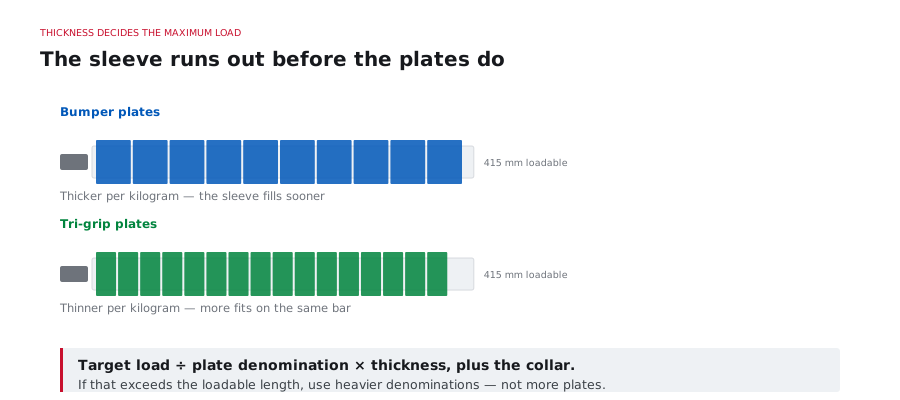
A bar has a fixed loadable sleeve length — 415 mm per side on a men's bar, 320 mm on a women's. Whether a facility can reach its target load depends on how much of that length each plate consumes.
Bumper plates are thicker per kilogram than tri-grip plates, because the material has to absorb an impact. So a platform equipped with bumpers reaches the end of the sleeve at a lower total weight than one equipped with tri-grips.
Work it through before quoting: target load, divided by the plate denomination, multiplied by thickness, plus the space a collar occupies. If the answer exceeds the loadable length, the facility needs heavier denominations rather than more plates.
What this means for storage
Two consequences that show up in fit-out drawings:
- Bumper storage is uniform. Constant diameter means a plate tree or wall rack takes any denomination in any position, which simplifies layout.
- Tri-grip storage is graduated. Varying diameters mean horns hold different quantities depending on what is on them, and a rack sized for 25 kg plates holds considerably more 5 kg plates in the same space.
The three grip holes matter here too. On a commercial floor plates are moved dozens of times a day, and a plate that can be carried one-handed is handled faster and dropped less.
Questions worth asking before a plate quotation
- Bumper or tri-grip? Dropped from overhead, or racked and loaded?
- What is the target maximum load on the bar?
- What bar? Loadable length differs between men's and women's.
- Any storage constraint? Wall length and rack type determine what is practical.
- Which denominations? Heavier denominations save sleeve length and cost less per kilogram.
The last point is the one buyers most often miss. Reaching 180 kg with 25 kg plates uses far less sleeve than reaching it with 10 kg plates, and usually costs less too.
Frequently asked
Why are all bumper plates 450 mm in diameter?
So the bar sits at a consistent height off the floor whatever the load. In weightlifting the pull is trained from that starting position, and a changing diameter would change the movement at every weight.
Do tri-grip plates have a constant diameter?
No. They are not dropped from overhead, so diameter steps down as weight decreases. Our 25, 20 and 15 kg plates are Ø450 mm with decreasing thickness, and lighter denominations step down in both.
Why does plate thickness matter more than diameter?
Because it determines how much weight fits on the bar. A men's bar has 415 mm of loadable sleeve per side; bumper plates are thicker per kilogram than tri-grip plates, so a bumper-loaded bar reaches its limit at a lower total weight.
How do I work out whether a bar can carry the target load?
Divide the target load by the plate denomination, multiply by plate thickness, and add the space taken by a collar. If the result exceeds the loadable sleeve length, use heavier denominations rather than more plates.
Does plate diameter affect storage planning?
Yes. Constant-diameter bumpers can go anywhere on a tree or wall rack, which simplifies layout. Tri-grip plates vary in diameter, so a rack sized for 25 kg plates holds considerably more 5 kg plates in the same space.

Written by the people who quote, tool and inspect the product at our own plant. Questions: sales@ironhue.com
Request a quotation
Send the list. Get price, lead time and container loading in one working day.
Item list, quantities and destination port are enough to start. Logo artwork and colour references can follow once the price is agreed.
- Emailsales@ironhue.com
- Phone / WhatsApp / WeChat+86 138 6042 3022
- OfficeIronhue Limited
Room 1203, No.5 Jinzhong Road, Huli District, Xiamen, China