
Quick answer
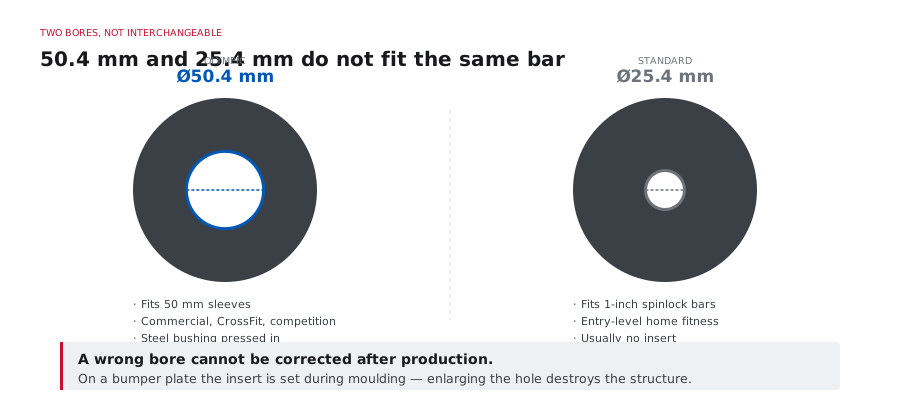
Weight plates come with either a 50.4 mm Olympic bore or a 25.4 mm standard bore. Olympic is the commercial and competition standard and fits 50 mm barbell sleeves. Standard fits older 1-inch home bars. The two are not interchangeable and cannot be adapted reliably. Confirm the bore in writing before quoting: a container of plates with the wrong hole is unsellable in the destination market, and there is no economical fix after the fact.
Almost every other mistake in a free-weight order can be worked around. Colour can be discounted, a logo can be reprinted on the next run, a delivery date can be renegotiated. A wrong bore cannot be fixed. The plates simply do not go on the bar.
The two sizes
| Olympic | Standard | |
|---|---|---|
| Bore diameter | 50.4 mm (2 in) | 25.4 mm (1 in) |
| Fits | 50 mm barbell sleeves | 1-inch spinlock bars |
| Typical market | Commercial gyms, CrossFit, competition, serious home gyms | Entry-level home fitness, older equipment |
| Insert | Stainless or chromed steel bushing | Usually none, or a simple sleeve |
| Our lines | All tri-grip and bumper plates | On request |
The 50.4 mm figure is not arbitrary: it gives working clearance over a 50 mm sleeve. A plate machined at exactly 50 mm binds; one machined too loose rattles and wears the sleeve.
Why a photograph will not tell you
Product photographs are usually shot straight on, and a 25 mm hole in a small plate and a 50 mm hole in a large plate can look proportionally similar. Buyers comparing supplier images regularly assume they are looking at the same specification.
Two habits prevent this:
- Ask in writing on the first exchange. Not “is it Olympic?” but “confirm bore diameter in millimetres”. The word Olympic gets used loosely.
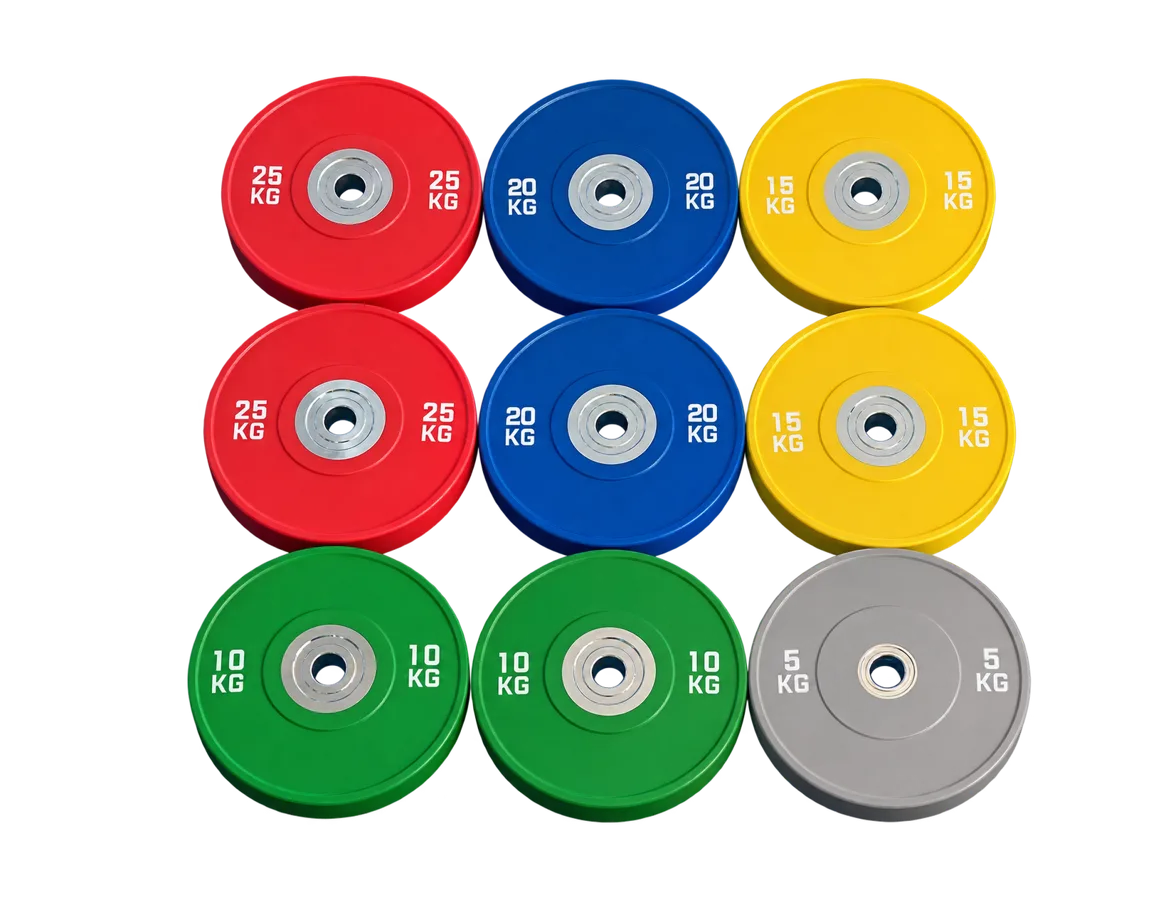
- Check the insert. Olympic plates almost always have a steel bushing pressed into the hole. A bare moulded hole usually means standard, or a low-cost Olympic plate that will wear quickly.
What a wrong bore actually costs
There is no practical rework. You cannot bore out a finished bumper plate: the insert is set during moulding and enlarging the hole destroys the structure around it. Sleeve adapters exist for the reverse case but are not accepted in commercial gyms, and no serious buyer will take them.
So the options after the fact are: sell into a different market segment at a heavy discount, or write the container off. Both are worse than one clarifying email.
Which one does your buyer actually need?
Three quick tests, in order of reliability:
- What bars do they already stock or own? The plates must match the bars, not the other way round. If they sell Olympic barbells, they need Olympic plates.
- What market segment? Commercial, CrossFit, competition and most serious home gym sales are Olympic. Standard survives mainly in entry-level retail and in replacement parts for older equipment.
- What do they call the bar? “Spinlock”, “1-inch” and “threaded” usually mean standard.
One more place this bites
Collars have the same split. A 50 mm collar will not hold on a 25 mm sleeve and a 25 mm collar will not go over a 50 mm one. Collars are often added late in a quotation as a small line item and inherit whatever assumption was made earlier — which is exactly when the wrong one slips through.
If a quotation covers bars, plates and collars, confirm the bore once and apply it consistently across all three.
Frequently asked
What is the difference between 50.4 mm and 25.4 mm bore plates?
50.4 mm is the Olympic bore, fitting 50 mm barbell sleeves used in commercial gyms, CrossFit and competition. 25.4 mm is the standard bore, fitting 1-inch spinlock bars found in entry-level home equipment. They are not interchangeable.
Can a standard bore plate be drilled out to Olympic?
No. On a bumper plate the steel insert is set during moulding and enlarging the hole destroys the structure around it. There is no economical rework once the plate is finished.
Why is the Olympic bore 50.4 mm and not 50 mm?
The extra 0.4 mm provides working clearance over a 50 mm sleeve. A plate machined at exactly 50 mm binds on the bar; one machined much looser rattles and accelerates sleeve wear.
How do I tell which bore a plate has from a photograph?
You often cannot, which is why it should be confirmed in writing. A useful clue is the insert: Olympic plates almost always have a steel bushing pressed into the hole, while a bare moulded hole usually indicates a standard plate.
Do barbell collars come in both sizes too?
Yes, and they are a common place for the error to slip through because collars are usually added late in a quotation. Confirm the bore once and apply it consistently to bars, plates and collars.

Written by the people who quote, tool and inspect the product at our own plant. Questions: sales@ironhue.com
Request a quotation
Send the list. Get price, lead time and container loading in one working day.
Item list, quantities and destination port are enough to start. Logo artwork and colour references can follow once the price is agreed.
- Emailsales@ironhue.com
- Phone / WhatsApp / WeChat+86 138 6042 3022
- OfficeIronhue Limited
Room 1203, No.5 Jinzhong Road, Huli District, Xiamen, China