
Quick answer
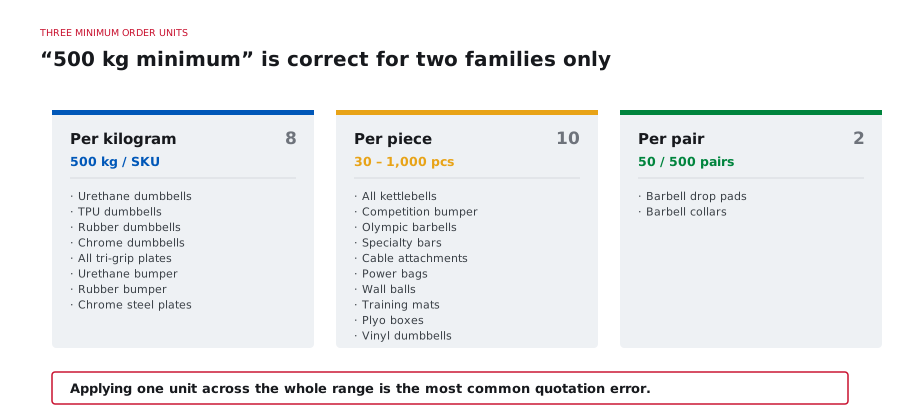
Free-weight MOQ is quoted in three different units depending on the line. Dumbbells and plates are quoted per kilogram (500 kg per SKU), because a 2.5 kg and a 40 kg piece consume completely different material and machine time. Kettlebells, bars and most accessories are quoted per piece (30–1,000 pcs depending on the line). Drop pads and collars are quoted per pair. Private label and custom Pantone start at 1,000 kg or 1,000 pcs. Always confirm which unit a quotation uses before comparing it with another supplier's.
A buyer asks for our minimum order and hears “500 kg per SKU”. They apply that to kettlebells, work out that 500 kg of 16 kg kettlebells is about 31 pieces, and build a first order around it. The quotation comes back very different, because kettlebells are not quoted by weight.
This is not a trick. The unit follows the way the product is made.
Three units, and which lines use them
| Unit | Lines | Typical minimum |
|---|---|---|
| Per kilogram | All dumbbells except vinyl, all tri-grip and bumper plates, chrome steel plates | 500 kg per SKU |
| Per piece | All kettlebells, competition bumper plates, bars and cable attachments, power bags, Bulgarian bags, wall balls, mats, plyo boxes, vinyl dumbbells | 30–1,000 pcs by line |
| Per pair | Drop pads, collars | 50 or 500 pairs |
Why weight-based makes sense for dumbbells and plates
A 2.5 kg rubber dumbbell and a 40 kg rubber dumbbell come off the same line, but they are not the same job. The 40 kg piece consumes sixteen times the cast iron, far more coating material, and considerably more press time per unit.
Quote both at the same price per piece and one of two things happens: the small sizes are overpriced and your retail customers reject them, or the large sizes are underpriced and the order loses money. Quoting by mass keeps the relationship between cost and price intact across the whole range.
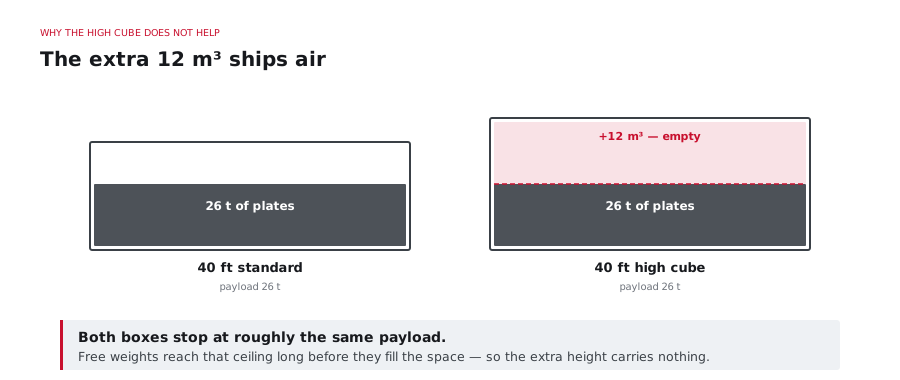
It also lines up with how the container works. Free weights are limited by payload, not volume, so thinking in kilograms from the first email means your MOQ, your quotation and your shipping plan all use the same unit.
Why kettlebells and bars are quoted per piece
A kettlebell is a single casting with a finished handle. The handle work, the coating and the finishing are much the same whether the body is 8 kg or 32 kg — the cost sits in the piece, not in the mass. Barbells are the same: the shaft machining, knurling and sleeve assembly dominate, and those do not scale with weight.
Sewn goods follow the same logic. A power bag is cutting, stitching and hardware. The filling is the cheap part.
What this means for a first order
Do not read one MOQ across the whole range
“500 kg per SKU” is correct for dumbbells and plates and wrong for everything else. Ask for the MOQ line by line, or work from the figure published on each product page.
SKU counts by weight increment, not by product
Urethane dumbbells are one product line but many SKUs. 2.5, 5, 7.5, 10 kg and so on are each their own minimum. A buyer who wants eight increments is looking at eight minimums, not one.
This is where first orders get unexpectedly large, and where a starter mix helps: spread the minimum across a sensible assortment rather than stacking 500 kg of a single weight in your warehouse.
Private label raises the floor
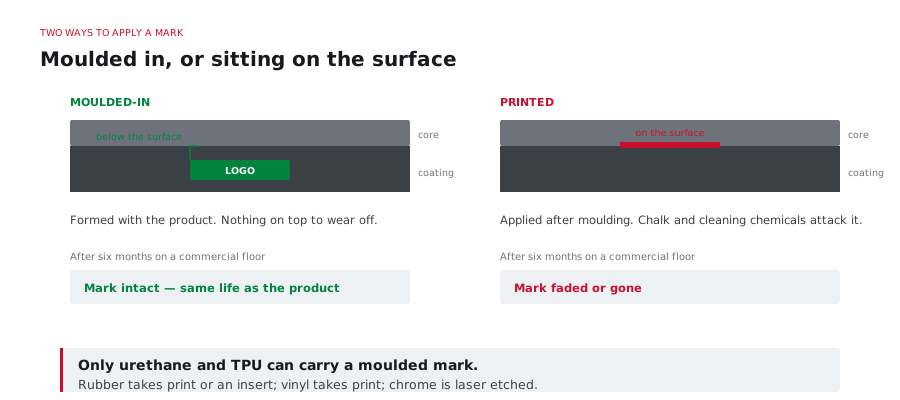
A moulded logo needs a tool per size, and a custom Pantone needs a colour batch. Both start at 1,000 kg or 1,000 pcs depending on the line. Printed or engraved marking carries no tooling and stays at the standard minimum — worth knowing if budget is tight on a first order.
Comparing quotations from different suppliers
Before comparing two quotations, confirm three things about each:
- The unit — kilograms, pieces or pairs
- What counts as one SKU — is each weight increment separate, or is the range treated as one?
- Whether the minimum is per SKU or per order — these differ by a large factor
A supplier quoting “300 kg” against our 500 kg may in fact have a higher effective minimum, if theirs is per colour and ours is per SKU. Quotations are only comparable once the units match.
Related reading: the five errors behind most quotation disputes.
Frequently asked
What is the minimum order for free weights?
It depends on the line and the unit. Dumbbells and plates are quoted per kilogram at 500 kg per SKU. Kettlebells, bars and most accessories are quoted per piece, from 30 to 1,000 pieces depending on the line. Drop pads and collars are quoted per pair, at 50 or 500 pairs.
Why are dumbbells quoted by weight instead of by piece?
A 2.5 kg and a 40 kg dumbbell come off the same line but consume very different amounts of material and press time. Pricing both per piece would either overcharge the small sizes or lose money on the large ones.
Does each weight increment count as a separate SKU?
Yes. 2.5 kg, 5 kg and 7.5 kg are three SKUs, each with its own minimum. A buyer wanting eight increments is looking at eight minimums, which is why first orders are often larger than expected.
Is the MOQ higher for private label?
Yes. A moulded logo requires a tool per size and a custom Pantone requires a dedicated colour batch, so both start at 1,000 kg or 1,000 pieces. Printed or engraved marking needs no tooling and stays at the standard minimum.
How do I compare MOQs between two suppliers?
Confirm the unit, what counts as one SKU, and whether the minimum applies per SKU or per order. A lower headline number can be a higher effective minimum once those three are aligned.

Written by the people who quote, tool and inspect the product at our own plant. Questions: sales@ironhue.com
Request a quotation
Send the list. Get price, lead time and container loading in one working day.
Item list, quantities and destination port are enough to start. Logo artwork and colour references can follow once the price is agreed.
- Emailsales@ironhue.com
- Phone / WhatsApp / WeChat+86 138 6042 3022
- OfficeIronhue Limited
Room 1203, No.5 Jinzhong Road, Huli District, Xiamen, China