
Quick answer
Five recurring errors: quoting MOQ in the wrong unit (kilograms, pieces and pairs are not interchangeable); quoting one lead time for all lines when cast urethane takes far longer than rubber; claiming certification that does not apply to loose free weights; stating performance figures nobody has independently tested; and repeating container quantities that ignore payload limits. Each is avoidable by checking rather than recalling.
A buyer receives a quotation, places an order, and discovers the terms were not what they understood. In most cases nobody intended to mislead them. Somebody answered from memory.
These are the five that recur, described from the side of the plant that has to deliver against them.
1. MOQ quoted in the wrong unit
The single most frequent error.
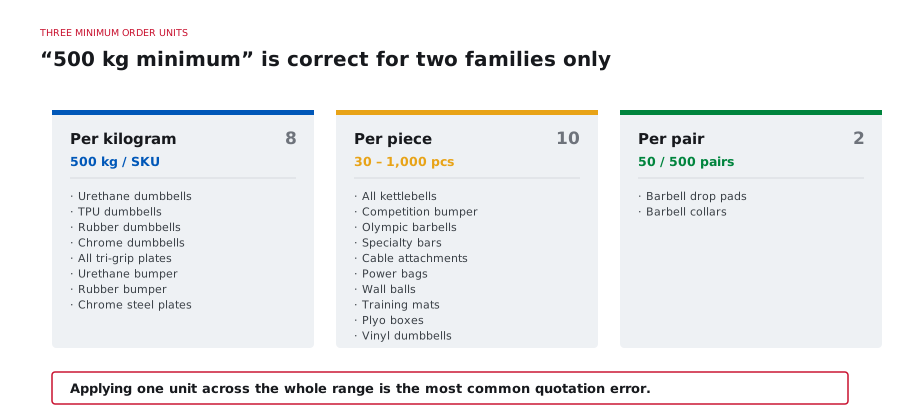
Someone says “500 kg minimum”. But kettlebells are quoted per piece and collars per pair. Three different units, and they are not interchangeable.
A buyer applying a kilogram minimum to kettlebells arrives at a completely different quantity from the one that will actually be quoted. The full breakdown is in why MOQ is quoted in kilograms, pieces or pairs.
Correct approach: quote the unit alongside the number, every time. 500 kg per SKU and 300 pieces are both clear; 500 minimum is not.
2. One lead time applied to every line
Lead time varies substantially by line, because cure time varies by material. Cast urethane is not rubber and neither is plated steel.
And a first order with a new moulded logo carries tooling and trial approval on top, as set out in which parts of a lead time can be compressed.
Correct approach: quote the line's own lead time, and state whether tooling is included in it.
3. Certification claimed that does not apply
Two claims appear repeatedly in this industry and neither survives examination.
| Claim | Problem |
|---|---|
| “CE certified” | Loose free weights fall outside the scope of the relevant directives |
| “EN 957 compliant” | EN ISO 20957 covers stationary training equipment — racks, benches, machines — not loose weights |
A buyer who checks will find this, and having found one claim that does not hold they will reasonably doubt the rest.
Correct approach: state what is actually held. Where a market requires independent test data, the right answer is that the buyer can appoint their own agency — which is also a stronger answer than a certificate nobody reads.
4. Performance figures stated without testing
Salt spray hours, drop counts, Shore hardness, tensile strength, load ratings. These get quoted because they sound authoritative and because a competitor quoted them first.
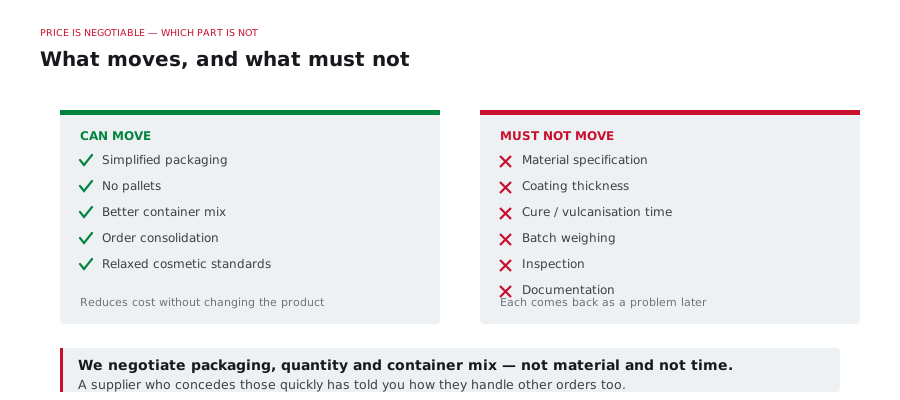
If we have not had it independently tested, we do not put a number on it. A figure the customer can send to a laboratory and disprove is worse than no figure at all.
This is particularly serious on barbells, where load rating and tensile strength relate to safety rather than to durability.
Correct approach: describe construction and materials, which are known, and supply performance figures only where test data exists.
5. Container quantities repeated from an old order
Container quantity is a property of an assortment, not of a product. Change the weight mix or the packing, and it changes.
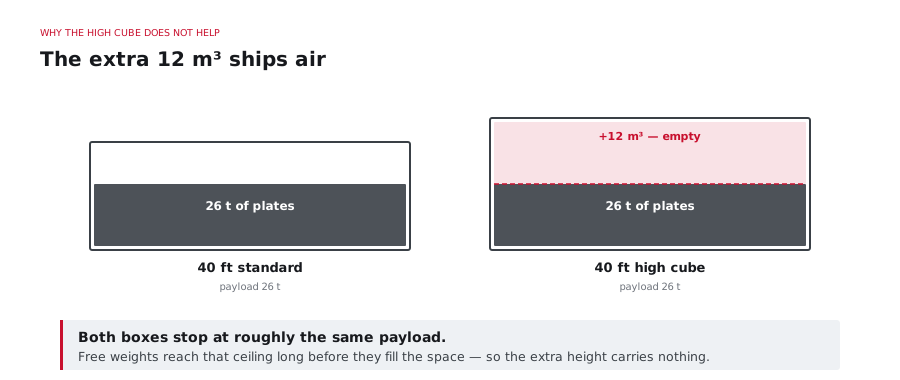
The related error is assuming a 40ft high cube carries more weight than a standard 40ft. It does not — both stop at roughly the same payload, and free weights reach that ceiling long before they fill the space.
Correct approach: recalculate against the actual assortment, and present the result as a planning estimate rather than a guarantee.
The rule underneath all five
If you are not sure, ask before you answer. A customer does not think less of you for checking. They think less of you for being confidently wrong.
Our own internal position is that sales must confirm with production before committing on lead time, capability or any figure that will end up in a contract. It slows a reply by a few hours and prevents a dispute that takes weeks.
For buyers: five questions that surface all of this
- What unit is that minimum in? Kilograms, pieces or pairs.
- Is that lead time for this specific line, and does it include tooling?
- Which certificates do you actually hold, and can I see one?
- Has that performance figure been independently tested, and by whom?
- Was that container quantity calculated for my assortment?
None is confrontational. All five are answered in one email by a supplier who knows their own product.
Written with our technical manager, who has spent twenty years on the floor of a free-weight plant. Customer details are withheld; the incidents are not.
Frequently asked
What is the most common mistake in free-weight quotations?
Quoting the minimum order in the wrong unit. Dumbbells and plates are quoted per kilogram, kettlebells and bars per piece, and collars and drop pads per pair. The three are not interchangeable.
Is CE certification valid for dumbbells and weight plates?
Loose free weights fall outside the scope of the relevant directives, so a CE claim on them does not hold up. EN ISO 20957 is also frequently misquoted: it covers stationary training equipment, not loose weights.
Why do some suppliers avoid quoting performance figures?
Because a figure without independent test data is worse than no figure. A buyer can send a sample to a laboratory and disprove it, which is particularly serious on barbells where load rating relates to safety.
Can a container quantity from a previous order be reused?
No. Container quantity depends on the assortment, packing and destination. It should be recalculated for each order and presented as a planning estimate rather than a guarantee.
What should a salesperson do when unsure of a technical answer?
Say that it needs to be confirmed with the technical team, then follow up in writing. Customers do not lose confidence in a supplier who checks; they lose confidence in one who is confidently wrong.

Written by the people who quote, tool and inspect the product at our own plant. Questions: sales@ironhue.com
Request a quotation
Send the list. Get price, lead time and container loading in one working day.
Item list, quantities and destination port are enough to start. Logo artwork and colour references can follow once the price is agreed.
- Emailsales@ironhue.com
- Phone / WhatsApp / WeChat+86 138 6042 3022
- OfficeIronhue Limited
Room 1203, No.5 Jinzhong Road, Huli District, Xiamen, China