
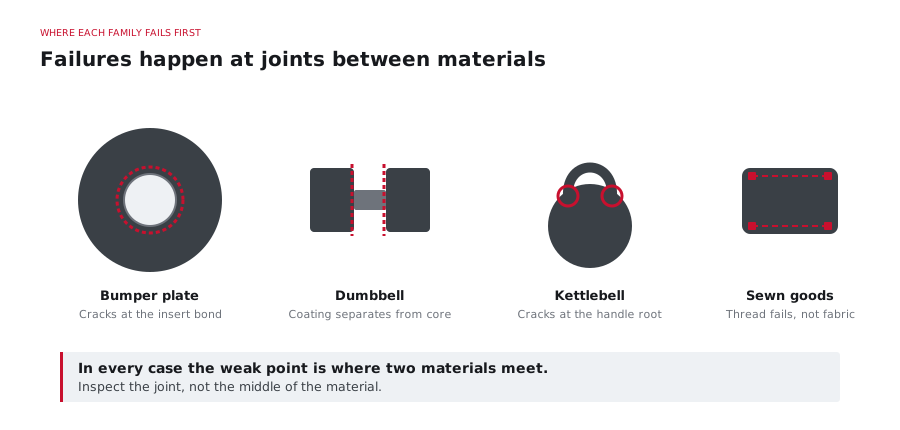
Quick answer
Complaints fall into three categories: manufacturing fault, usage fault, and genuinely unclear. The most reliable single indicator is timing — failure on arrival or within weeks points to production; failure after extended service points to normal wear; failure at around a month is the one that needs investigation. The second indicator is the failure mode: whether the break matches the characteristic pattern for that product or looks unusual.
A gym reports that a bar is bent or a dumbbell is loose. The distributor is between a customer who wants a replacement and a supplier who wants evidence. Handled badly it damages both relationships.
Our technical manager sorts every complaint into three categories before anything else happens.
Category one: our problem
Weight outside tolerance, wrong colour, a bond that has failed, a defect visible on arrival.
If it is our fault, we take it. Replace it, credit it, whatever is appropriate. Arguing about a genuine defect costs more than the goods.
These are usually easy to identify because they show up early and match a known production failure mode.
Category two: usage
Overloading, dropping a bar that is not rated for it, using a chrome product in a wet environment, equipment used outside its intended purpose.
How this is handled matters more than the conclusion:
I do not say “this is your fault”. I show the customer what the product is designed for and let them reach the conclusion themselves. Told they are wrong, people defend their position. Shown the evidence, they usually work it out.
This is the difference between winning an argument and keeping an account.
Category three: genuinely unclear
Failure after long service, or in a way that does not match any familiar pattern.
These we negotiate. The customer should not be out of pocket, and neither should we. Trying to win every one of these is how you lose the account.
Timing is the most reliable indicator
| When it failed | Usually indicates |
|---|---|
| On arrival or within days | Production or transport — our problem |
| Around a month | Unclear; needs investigation |
| After a year or more | Normal wear, unless the failure mode is unusual |
The middle row is the interesting one. A month is long enough that it is not an obvious defect and short enough that it is not fair wear, which is exactly why it deserves attention rather than a default answer in either direction.
Failure mode is the second indicator
Every product family has a characteristic way of failing, described in how free weights actually fail. A break that matches the pattern is probably ordinary; one that does not is worth a closer look.
The clearest example is a bent barbell:
| Bend | Points to |
|---|---|
| Centred and symmetrical | Material or heat treatment |
| Off to one side, irregular | Overloading or uneven loading |
The questions to ask before deciding
- When did it fail? Date of delivery and date of failure.
- How was it being used? Load, frequency, environment.
- Photographs of the failure, and of the whole piece.
- Is it one piece or several? A pattern across a batch changes the analysis entirely.
- Are there batch markings? Traceability to a production date and shift.
The fourth question matters most. A single failure is an incident; several from the same batch is a production issue, and a manufacturer should want to know about it.
Batch traceability is also why we weigh and record every batch rather than sampling, as set out in the article on weight tolerance. A complaint that can be traced to a production date and shift is a complaint that can actually be investigated.
What a distributor should do first
Before contacting the supplier, collect the five items above. A claim arriving with photographs, dates and batch information is resolved in one exchange. A claim arriving as “the customer says it broke” takes four.
And treat the environment question seriously. A chrome product corroding in a humid coastal gym is not a plating defect — it is the wrong product for the location, which should have been caught at the quotation stage.
Why we publish this
Setting out how these decisions are made is more useful than a warranty clause nobody reads. A distributor who knows the framework can answer their own customer immediately, and a supplier who explains the reasoning is easier to deal with when something does go wrong.
Written with our technical manager, who has spent twenty years on the floor of a free-weight plant. Figures that would require independent laboratory testing are deliberately not quoted here.
Frequently asked
How do you tell a manufacturing defect from misuse?
Timing and failure mode. Failure on arrival or within days points to production; failure after long service points to wear. A break matching the characteristic pattern for that product is usually ordinary, while an unusual one warrants investigation.
What information should a distributor collect before filing a claim?
Delivery and failure dates, how the item was used, photographs of both the failure and the whole piece, whether one or several pieces failed, and any batch markings. A claim with all five is resolved in one exchange.
Does a single failure indicate a batch problem?
Not usually. A single failure is an incident; several from the same batch is a production issue, and a manufacturer should want to know about it because it may affect other shipments.
How should a supplier handle a complaint that turns out to be misuse?
By showing the customer what the product is designed for rather than telling them they are at fault. People defend a position when told they are wrong and usually reach the conclusion themselves when shown the evidence.
Is corrosion on chrome equipment a manufacturing defect?
Usually not, if the environment is humid. Chrome suits dry settings such as boutique studios, hotels and residential gyms. In a coastal or humid facility the specification was wrong, which should be caught before the order.

Written by the people who quote, tool and inspect the product at our own plant. Questions: sales@ironhue.com
Request a quotation
Send the list. Get price, lead time and container loading in one working day.
Item list, quantities and destination port are enough to start. Logo artwork and colour references can follow once the price is agreed.
- Emailsales@ironhue.com
- Phone / WhatsApp / WeChat+86 138 6042 3022
- OfficeIronhue Limited
Room 1203, No.5 Jinzhong Road, Huli District, Xiamen, China