
Quick answer
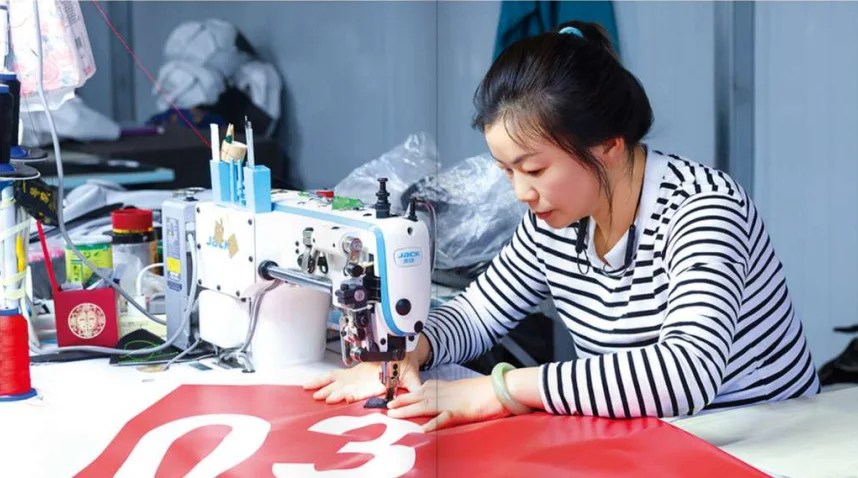
Sewn and foam products are specified by fabric weight in gsm and foam density in kg/m³. Our power bags use 900D polyester at roughly 300 gsm with reinforced webbing; training mats use EPE foam at roughly 25 kg/m³. European tenders ask for both as a matter of routine, and a bid that omits them is usually set aside without further reading. Both figures are material properties, so they can be quoted with confidence in a way that performance claims cannot.
A buyer specifying dumbbells needs a weight and a coating. A buyer specifying power bags or training mats needs to know what the product is made of, because two bags of identical weight can be built very differently.
Fabric weight: gsm and denier
Two numbers describe a technical fabric and they are not interchangeable.
| Denier (D) | gsm | |
|---|---|---|
| Measures | Thickness of the individual yarn | Weight of a square metre of finished fabric |
| Tells you | Yarn robustness | How much material is actually there |
| Our power bags | 900D polyester | approx. 300 gsm |
A high denier woven loosely can weigh less per square metre than a lower denier woven tightly. Tenders ask for gsm because it is harder to make flattering.
What else carries the load
Fabric is only part of it. On a bag that gets thrown and dragged, failures usually start at the stress points rather than in the middle of a panel:
- Webbing on the handles — width and whether it is bar-tacked
- Stitch type at anchor points — single, double or reinforced
- Closure — the hardware and how it is attached
The same applies to wall balls, where the seam takes the impact, and to Bulgarian bags, where the handles carry the whole load during rotational work.
A tender that asks only for gsm is asking a reasonable question incompletely. If you are writing the specification, ask about the stress points too.
Foam density: kg/m³
Density describes how much material occupies a given volume, and it drives almost everything a buyer cares about in a mat.
- Too low — compresses permanently, develops hollows under racks and heavy traffic
- Too high — unnecessarily heavy and expensive, and harder on the joints for floor work
Our mats use EPE foam at roughly 25 kg/m³, at 1800 × 600 × 40 mm. Density and thickness have to be read together: a thick low-density mat and a thin high-density mat behave very differently under a loaded rack.
Why tenders insist on these figures
Three reasons, and they apply well beyond Europe:
- They are comparable. A procurement officer can line up five bids and compare gsm directly. “Heavy duty” cannot be compared to anything.
- They are verifiable. Fabric weight and foam density can be measured on a delivered sample.
- They are material properties, not performance claims. A supplier can state them honestly without holding test certification — unlike drop ratings or load ratings, which require independent testing.
That last point is why we publish these figures and not others. They describe what the product is made from, which we know, rather than how it will behave under test, which we have not independently measured.
The rest of a European tender
Alongside material figures, expect to be asked for:
- REACH and PAHs compliance on coated and rubber goods
- Dimensional tolerance on mats and boxes
- Packaging and labelling, including language requirements
- An EU responsible person under the General Product Safety Regulation
The same documentation logic applies to plyo boxes, where load rating is the figure tenders ask for and the one that needs independent testing rather than a supplier's word.
That last item catches out suppliers regularly. A non-EU manufacturer must have a responsible person established in the EU; in practice this is often the importer, and it should be agreed in writing rather than assumed.
We publish the specifications we can evidence and do not publish certification we do not hold. Where a tender requires independent test data, appoint an agency of your choosing and we will supply samples.
Frequently asked
What does gsm mean on gym bags and mats?
Grams per square metre: the weight of a square metre of finished fabric. It indicates how much material is actually present, which denier alone does not, since a high-denier yarn woven loosely can weigh less than a lower denier woven tightly.
What fabric do your power bags use?
900D polyester at approximately 300 gsm, with reinforced webbing at the handle anchor points.
What foam density should a training mat have?
It depends on use. Too low and the mat compresses permanently under racks and heavy traffic; too high and it is needlessly heavy and hard for floor work. Our mats use EPE foam at roughly 25 kg/m³ at 40 mm thickness.
Why do European tenders ask for gsm and foam density?
Because they are comparable between bids, verifiable on a delivered sample, and are material properties rather than performance claims, so a supplier can state them without holding test certification.
What else does a European tender usually require?
REACH and PAHs compliance on coated goods, dimensional tolerance, packaging and labelling requirements, and an EU responsible person under the General Product Safety Regulation.

Written by the people who quote, tool and inspect the product at our own plant. Questions: sales@ironhue.com
Request a quotation
Send the list. Get price, lead time and container loading in one working day.
Item list, quantities and destination port are enough to start. Logo artwork and colour references can follow once the price is agreed.
- Emailsales@ironhue.com
- Phone / WhatsApp / WeChat+86 138 6042 3022
- OfficeIronhue Limited
Room 1203, No.5 Jinzhong Road, Huli District, Xiamen, China